Ruins Worth Living In: The Communities That Thrive Inside Broken Machines
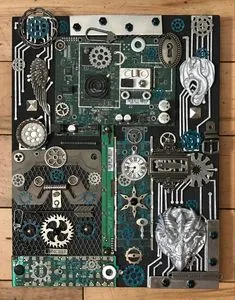
Photo: vintage retro broken electronics circuit board creative art, via i.pinimg.com
There is a particular kind of attention that a broken thing demands. Not the distracted half-presence of someone using a tool that works exactly as intended, but a focused, almost forensic engagement with something that has gone wrong in a specific and interesting way. This quality of attention — close, curious, undeceived by the smooth surface of designed functionality — is the founding disposition of some of the most generative creative communities operating in the United States today.
They are building with wreckage. And the results are remarkable.
Why Broken Attracts the Curious
Functional technology is, in a sense, a closed system. It performs its intended operation and discourages deviation. The interface guides you toward expected outcomes. The software flags errors. The hardware resists modification. This is by design — consumer technology is engineered to minimize friction, which means minimizing the possibility of doing something the manufacturer did not anticipate.
Broken technology is a different proposition entirely. When a system fails, it reveals itself. The internal logic becomes visible through its violation. The gap between what the machine was supposed to do and what it is actually doing becomes a space of possibility rather than a problem to be solved.
For a certain kind of creative mind, that gap is precisely the point.
This is not mere nostalgia, though nostalgia is sometimes part of the texture. It is something closer to a philosophical stance — a preference for systems that can be genuinely known and genuinely subverted over systems that present a managed, mediated surface.
Circuit Bending and the Art of the Productive Malfunction
The practice of circuit bending — deliberately modifying the circuitry of electronic devices, often battery-powered children's toys, to produce unintended sounds and behaviors — has existed as a named discipline since the late 1960s, when musician Reed Ghazala discovered that short-circuiting a small amplifier produced extraordinary sounds. The practice has never disappeared, and in the past decade it has experienced a significant resurgence among younger artists and musicians who encounter it through online communities and maker spaces.
What circuit bending produces is not predictable. That is, again, the point. By bridging circuit points that were never designed to connect, practitioners introduce randomness, feedback, and instability into systems engineered for reliability. The resulting sounds — distorted, alien, often beautiful in their wrongness — cannot be replicated by conventional synthesis. They are artifacts of a specific malfunction in a specific machine.
Communities organized around this practice have developed their own taxonomies, their own aesthetics, their own hierarchies of knowledge. Online forums and Discord servers host ongoing conversations about which devices reward modification most generously, how to document and share circuit diagrams, and how to think about the ethics of destroying functional objects in order to make art.
The Game Boy, in particular, has become something of a totemic object in this world. Through circuit bending, custom firmware, and dedicated software like LSDJ, the 1989 Nintendo handheld has been transformed into a legitimate instrument with a devoted global following. The lo-fi, 8-bit sound palette it produces — constrained, immediately recognizable, technically limited — has become the aesthetic signature of an entire musical genre. Its limitations are not obstacles. They are the instrument.
Glitch Art and the Beauty of the Corrupted File
Parallel to the physical practice of circuit bending exists a community organized around digital corruption itself. Glitch art — the deliberate introduction of errors into image, video, and audio files — operates on the same fundamental principle: that the failure modes of a system reveal a kind of beauty and meaning that normal operation forecloses.
Practitioners of databending, a related technique, open image files in audio editing software and apply effects designed for sound waves to the raw data of a photograph. The results — fractured, pixelated, streaked with color artifacts — look like the visual equivalent of a transmission breaking apart. They look, in other words, like something going wrong. And they look extraordinary.
The community that has formed around these practices is self-consciously resistant to the values of mainstream digital aesthetics: resolution, fidelity, seamlessness, polish. Glitch artists frequently describe their work as a critique of technological perfectionism, a way of insisting on the presence of the machine in the image rather than allowing it to disappear behind its own output.
This is not an obscure academic conversation. Glitch aesthetics have migrated into mainstream visual culture — appearing in music videos, album covers, fashion campaigns, and web design — while the community of practitioners who take the practice seriously continues to develop in relative obscurity, largely indifferent to its commercial appropriation.
The Demoscene: Constraint as Competition
Perhaps no community illustrates the creative potential of technological limitation more vividly than the demoscene — a subculture with deep roots in American and European computing culture that produces real-time audiovisual demonstrations within extreme technical constraints.
Demosceners write programs that generate elaborate visual and audio experiences within file sizes that would seem, to a contemporary observer, impossibly small. Four kilobytes. Sixty-four kilobytes. The challenge is not simply to make something beautiful but to make something beautiful within a constraint that forces total mastery of the underlying system.
The demoscene emerged from the cracking communities of the 1980s and has persisted through every subsequent era of computing, adapting to new hardware while maintaining its foundational commitment to constraint-based creation. Its practitioners possess technical skills that command significant respect even outside the subculture — but many of them have little interest in applying those skills in contexts that do not impose the productive difficulty they have come to value.
What These Communities Share
Across circuit bending, glitch art, the demoscene, and the broader ecology of broken-technology creativity, certain themes recur with enough consistency to suggest something more than coincidence.
These communities tend to be suspicious of the managed, the optimized, and the frictionless. They find value precisely where mainstream technology culture locates failure. They have developed sophisticated languages for talking about the qualities of specific broken systems — the particular character of a corrupted JPEG versus a corrupted MP3, the specific sound signature of a bent circuit in a Speak & Spell versus a bent circuit in a Casio keyboard.
They are, in this sense, practicing a form of close reading — attending to the specific, material particularity of the systems they work with in a way that most technology use actively discourages.
And they are building lasting communities. Not communities defined by shared consumption of a product, but by shared mastery of a practice. The knowledge accumulated in these spaces — technical, aesthetic, historical — is genuine and not easily replicated.
The Ruin as Foundation
There is something worth sitting with in the image of communities thriving inside the ruins of dead technology. It suggests that the cycle of obsolescence and abandonment that defines the technology industry does not simply produce waste. It produces raw material.
Every system that goes dark, every format that loses support, every device that becomes too slow to run contemporary software — each of these is also a constraint, a limitation, a set of rules that a certain kind of creative person will find irresistible.
The static, in other words, is not just noise. Sometimes it is the medium.