The Unwilling Librarians: Meet the People Preserving What the Internet Forgot
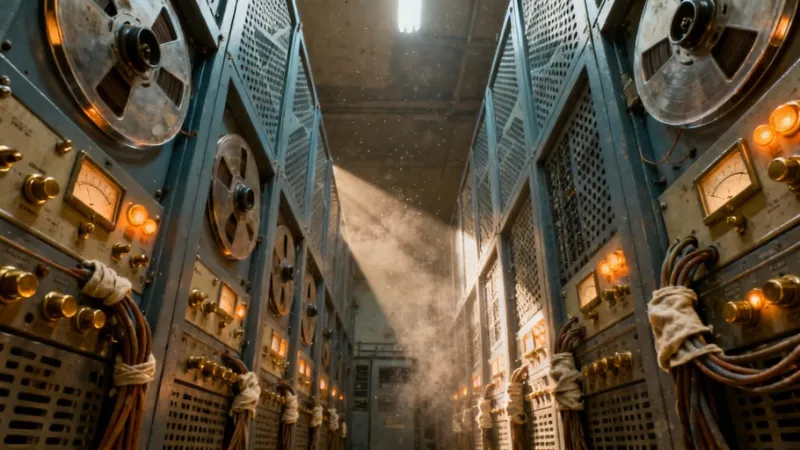
Photo: vintage computer server basement hard drives, via images.stockcake.com
In a climate-controlled basement outside Columbus, Ohio, a retired network administrator maintains a rack of hard drives holding roughly forty terabytes of material that, by any commercial measure, is worthless. Shareware installation guides. A mirror of a Cleveland-area ISP's customer help pages from 1996. Several thousand pieces of ASCII art traded across dial-up bulletin board systems before most Americans had heard of the World Wide Web.
He is not paid for this. No institution commissioned it. And yet, if his drives fail, the material simply ceases to exist.
The Accidental Archivists
Voluntary digital hoarding is not a new phenomenon, but its scale and stakes have grown considerably. As platforms shutter and link rot consumes the early web at an accelerating rate, a loose network of individuals — often self-taught, often anonymous — has taken up preservation work that museums and libraries have neither the budget nor the mandate to attempt.
What distinguishes these hoarders from conventional collectors is the absence of value logic. They are not assembling assets or building reputations. Many refuse to publish indexes of what they hold, reasoning that obscurity is part of the material's character. Their collections are, in a sense, private acts of memory performed on behalf of a public that has never asked for them.
Why the Mainstream Forgot, and Why They Didn't
The economics of the modern internet reward recency. Content that cannot generate engagement is functionally invisible, and content that is invisible is, eventually, deleted — not through malice but through the quiet arithmetic of storage costs and unmaintained servers.
The hoarders operate outside that arithmetic. One archivist in Oregon described her work preserving defunct software documentation as 'a hobby that got out of hand, then got serious.' She began by rescuing a single printer driver manual; six years later, she curates a repository consulted by retrocomputing enthusiasts, software historians, and occasionally a lawyer untangling a legacy licensing dispute.
Their motivations vary. Some describe a duty to the people who made things — the hobbyist coders and amateur artists whose work deserves to outlive the platforms that hosted it. Others admit to something closer to compulsion. But a recurring theme is a distrust of institutional memory: they have watched corporations delete decades of culture during migrations, mergers, and quiet sunsets, and concluded that no one is coming to save it.
What the Collections Reveal
Read together, these private archives sketch a portrait of an internet that official histories tend to flatten. Regional web ephemera — the personal pages of local clubs, the menus of dial-up boards serving a single area code — show that the early network was less a global village than a patchwork of small towns. The material is parochial, unpolished, and frequently mundane, which is precisely why it matters.
The mainstream internet, in its self-told history, remembers the launches: the browsers, the platforms, the revolutions. The hoarders remember the usage. They remember what ordinary Americans actually did online when nobody was measuring.
The Fragility of Devotion
There is an obvious vulnerability in this model. Preservation dependent on individual devotion is preservation dependent on individual mortality. Hard drives fail. Interest fades. Some collectors have begun coordinating handoffs — deliberate transfers of collections to younger caretakers — a practice that resembles nothing so much as an informal, digital estate law.
Whether this counts as a sustainable archival strategy is debatable. But the alternative, increasingly, is nothing at all. The web forgets by default; it remembers only when someone decides to care. The hoarders are proof that the deciding can still happen — one drive, one basement, one unasked-for archive at a time.